Ever Wonder How Jeju Made Salt Without a Single Mudflat?
sun and wind become salt
When people think of Jeju's sea, turquoise water and haenyeo divers usually come to mind first. But surprisingly few visitors know that there used to be salt fields right along that same coast. Jeju's volcanic terrain makes it hard to find the wide mudflats that mainland salt farms usually rely on, so making salt the mainland way was said to be difficult here. And yet Jeju people are said to have found their own way to make salt, which I find genuinely fascinating every time I hear about it. Today GYULI wants to walk you through Jeju-style stone salt, and through Gueom-ri in Aewol-eup, where traces of these old stone salt fields still remain.
Rock Instead of Mudflat: Jeju's Stone Salt Fields
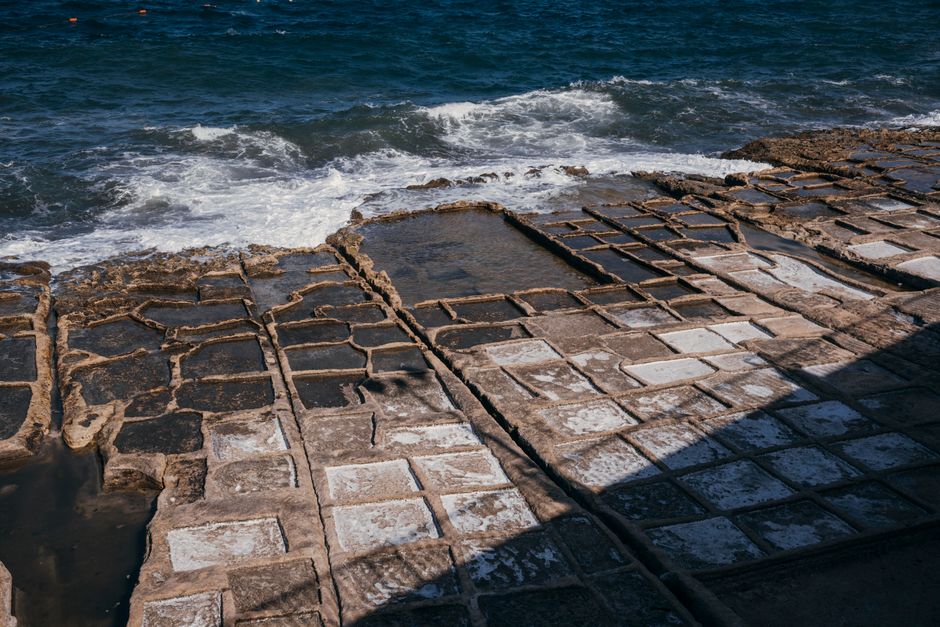
Mainland salt farms are usually built by walling off a wide mudflat and drawing seawater in. But Jeju's volcanic landscape made that kind of mudflat hard to come by. Instead, Jeju people are said to have turned their attention to the wide, flat basalt outcrops along the coastline. They would draw seawater up onto these flat rocks and let it pool there, then let the intense sun and Jeju's characteristic wind slowly evaporate the water until white salt crystals were left behind. With no mudflat to work with, they essentially made a field out of bare rock — an idea I find deeply, quintessentially Jeju. The salt made this way came to be called 'stone salt,' and the rock fields where it was made are known as 'stone salt fields.'
The sea never gave us a mudflat, so people turned bare rock into a field and harvested salt from it. Every grain of it took someone's hands.
— 🍊 GYULIAmong these stone salt fields, the one said to still show its traces most clearly today is the area around Gueom-ri, in Aewol-eup, Jeju City. Wide, flat rock formations stretch along the coast there, and locals are said to have long called this place 'Sogeumbille.' In Jeju dialect, 'bille' refers to a wide, flat rock — so the name itself carries the memory of what this land was once used for. In the old days, villagers are said to have carried seawater by hand to pour onto this Sogeumbille, then dried it under the sun and wind for days at a time to gather the salt.
Mostly Stopped Now, Yet the Traces Remain
That said, visiting Gueom-ri today doesn't mean you'll see salt actually being made the old way. As cheap, easily available salt spread widely, this labor-intensive stone salt production is thought to have quietly stopped, bit by bit, at some point — GYULI can only guess. I'd rather not pin down exactly when production tapered off, since that's not something I can state with confidence here. What's said, though, is that most of the Sogeumbille today stand more as relics showing the old method than as active production sites. Still, looking out over the wide rock fields and the traces left here and there, I find myself picturing the hands that once gathered salt on this very spot.
Facing Those Traces in Gueom-ri
The Gueom-ri coast is said to have a walking path and information signs meant to keep the memory of this stone salt field alive. Walking along the wide rock formations, you can take in both the sea and the village at once, which apparently makes it a pleasant stop for a stroll even if you don't know the salt story at all. But as mentioned, whether any actual production or hands-on viewing is happening at any given time can vary, so I can't state that with certainty here. So I'd rather offer this story not as one more sight to check off, but as a chance to remember the resourcefulness of people who found their own way to make a living even on such unforgiving land.
As a tourist in Jeju, it's easy to think of salt as just another common seasoning sold at the supermarket and move right past it. But once you know that people once turned bare rock into a field and waited days on end for sun and wind just to gather a handful of it, the Gueom-ri coastline starts to look a little different. Instead of just another quick photo stop, I hope it becomes a trip where you pause to think about the resourcefulness carved into this rocky field.

GYULI's Tip · The Gueom-ri stone salt field (Sogeumbille) sits along the coast of Aewol-eup, Jeju City, and is said to be more convenient to reach by car. Whether any production or hands-on viewing is currently taking place can vary by season, so please check the current operating status before you visit.