Is there really water at the top? The story of Geumoreum, a sunset oreum
Last time, while talking about Yongnuni Oreum, I briefly touched on how many different expressions the oreum landform can have. Today I want to introduce one with a particularly special story — Geumoreum, located on the western side of Jeju, around Geumak-ri in Hallim-eup. If Yongnuni Oreum is the oreum beloved on Jeju's eastern side, around Gujwa-eup, for its single soft ridgeline, Geumoreum is said to be known on the exact opposite side, the west, for a completely different kind of charm. It's known for two stories in particular: that when it rains, water is said to pool in the summit crater and form a small pond, and that an unusually large number of people are said to gather there around sunset. Today I'd like to slowly unpack both of those stories.
A round oreum sitting in the middle of the Hallim Geumak fields
Geumoreum is said to be located around Geumak-ri in Hallim-eup, Jeju City. It's said to not be far from Hyeopjae Beach or Hallim Park, and because the surrounding area is said to be open ranchland and fields, the oreum's gently swelling shape is said to be easy to spot even from a distance. The western side of Jeju is said to have quite a few oreum, large and small, gathered together besides Geumoreum, but among them Geumoreum is said to stand out for how clearly its round summit crater remains visible, making its shape feel especially distinct compared to other oreum. The trail to the summit is said to alternate between wooden boardwalk and dirt path, and because the slope is said to be fairly gentle, it's said that quite a few people climb it together with children or elderly family members.
They say that when it rains, water pools at the summit crater and forms a small pond
The point where Geumoreum is said to differ a little from other oreum is its summit crater. Because the inside of the crater is a hollowed-out basin, it's said that after enough rain falls, rainwater can pool in that hollow and, for a moment, look like a small pond. Some say that clouds and the color of the sky reflect on the water's surface as if the sky itself had settled down onto the ground. That said, I want to be clear about one thing so there's no misunderstanding — the water at Geumoreum's summit is not said to be there all the time. It's said to pool temporarily right after rain or during rainier stretches, and during long dry, clear spells the basin is said to often be completely dry. So rather than thinking 'go and you're guaranteed to see the pond,' it's probably better to remember it as 'a scene you might get to see, if it's rained recently.'
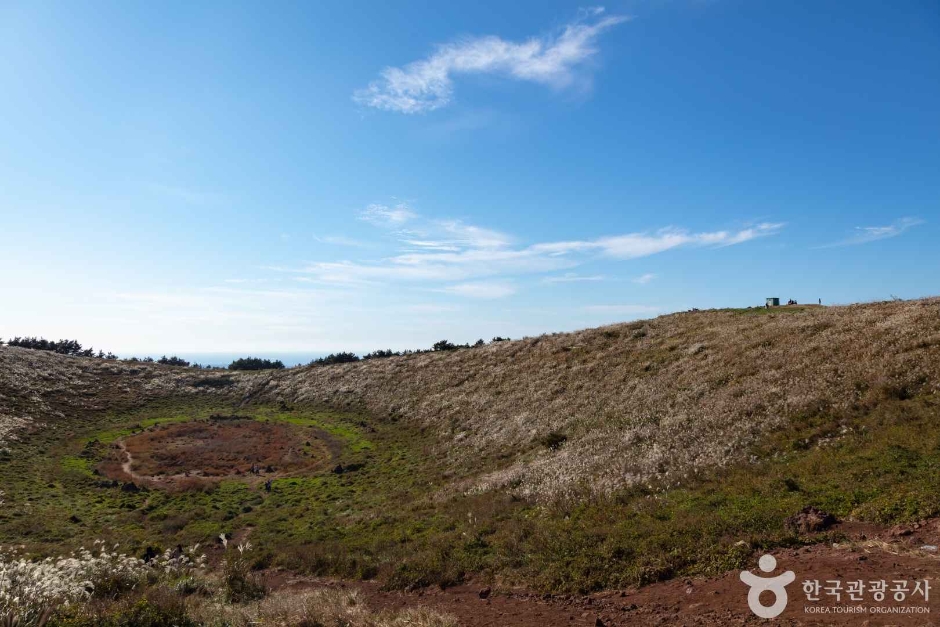


Because it isn't there all the time, people say it feels even more welcome. If you happen to catch that scene the day after rain, they say the whole day can end up feeling like a gift.
— 🍊 GYULIThinking of it as a pond that only shows its face briefly after rain somehow makes it feel even more special. If it were a view you could see anytime, you might just shrug it off — but because it's said to only appear under the right conditions, some people are said to deliberately check the rain forecast and climb the oreum the very next day just for a chance to see it. Of course, even if you don't catch the pond, the crater's round ridge and the gentle slope leading down into it are still said to be worth seeing on their own, so there's no need to feel too disappointed.
They say an unusually large number of people gather around sunset
Another reason Geumoreum's name comes up often among photographers is the sunset. From the summit, Biyangdo Island and the sea off Hyeopjae are said to come into view, and on clear days, even the ridgeline toward Hallasan is said to be visible. As the sun slowly sinks, the sky is said to turn red and make the whole scene even more striking. That's probably why, come evening, quite a few people are said to settle in along the summit ridge and wait for sunset. That said, because it's popular, parking is said to be limited, so if you're planning a visit around sunset, it's probably more comfortable to arrive with plenty of time to spare.
If Yongnuni Oreum, which I introduced last time, is an oreum that wins hearts on Jeju's east side with a single soft ridgeline, Geumoreum seems to be remembered on the west side for two different stories — the water in its crater, and its sunsets. It's fascinating that even though they share the same word 'oreum,' where they're located and why people visit them can be so different. Next time you find yourself heading to the western side of Jeju, timing your visit for the day after rain, or for sunset, might make a trip up Geumoreum a memory worth keeping.


GYULI's Tip · The pond at the summit crater isn't there permanently — it's said to pool only temporarily after rain. Check whether it's rained recently before you go, and if you're heading up for sunset, keep in mind that parking is said to be limited, so it helps to arrive with time to spare.