You Think You Know Mackerel? Wait Until You Try It Wrapped
wrapped and ready
When people talk about Jeju travel food, galchi (hairtail) or heukdwaeji (black pork) usually come to mind first, but lately a dish called godeungeo-ssambap, mackerel wrap rice, has also been showing up in recommendations. As it's become known that a fair amount of mackerel is caught in the waters around Jeju too, a spread built around thick-braised mackerel wrapped in lettuce has reportedly settled in as something of a local menu item. Mackerel usually brings to mind salted mackerel or grilled mackerel first, so braising it and then wrapping it in large lettuce leaves might feel a little unfamiliar. Today we're breaking down how godeungeo-ssambap comes together in Jeju, and why it's earned a place as a beloved spread. If galchi and heukdwaeji were the only fish stories you knew from Jeju, hopefully this introduces another side of what the surrounding sea has to offer.
Mackerel in Jeju's Waters Too, a Surprising Fact
Mackerel is usually known as a fish caught mostly in the South Sea or West Sea, but it's said that a fair amount is also caught in the waters around Jeju. Jeju's sea is where warm and cold currents meet, so a wide variety of fish species pass through, and mackerel is said to be among them, moving through Jeju's waters in schools depending on the season. Especially during the periods when water temperature shifts, plenty of well-fed mackerel are said to be caught, and mackerel caught in season is said to carry noticeably more fat. That deep flavor and tender texture typical of blue-backed fish is said to have expanded beyond simple grilling into other cooking styles, and godeungeo-ssambap is said to be one result of that.
As one of the representative blue-backed fish, mackerel is widely known for being rich in omega-3 fatty acids. Mackerel caught in Jeju's waters is also said to have firm flesh from growing in strong currents, and that firmness is said to mean the flesh holds together even after long braising. Thanks to that trait, the practice of braising thick-cut mackerel in a spicy sauce for a long time is said to have naturally taken hold in Jeju. Braised mackerel comes out with large, thick pieces of flesh, and paired with rice and lettuce wraps, it's said to make for a filling meal on its own.
Braise mackerel thick enough, they say, and it becomes a wrap rice spread of its own.
— 🍊 GYULIThick-Braised, Wrapped and Eaten as a Spread
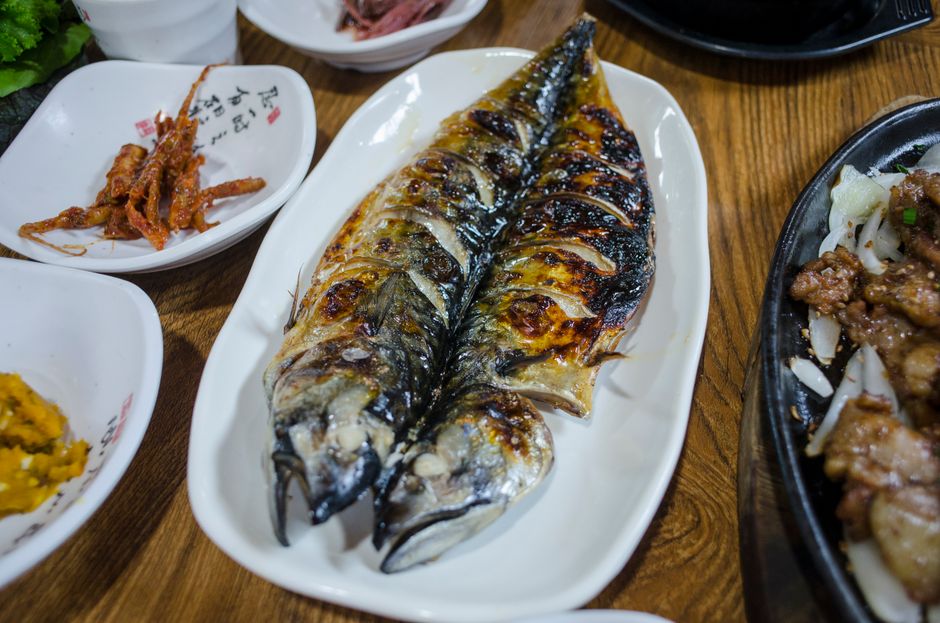
Godeungeo-ssambap, true to its name, is often introduced as a spread where thick-braised mackerel is wrapped in lettuce and eaten. It's said to be made by laying radish or potato at the bottom, pouring a sauce of red pepper flakes, garlic, and ginger until it nearly covers everything, and braising it for a long time. Through that long braise, the sauce is said to soak deep into the mackerel's flesh, and the fish's natural fat combined with the spicy seasoning is said to produce a rich flavor. The finished braise is cut into large pieces and placed at the center of the table, typically served alongside lettuce or perilla leaves, ssamjang, and a bowl of warm rice.
The way it's eaten is fairly simple too, a spoonful of rice on a lettuce leaf, a thick piece of braised mackerel on top, a bit of ssamjang, then wrapped up into a large bite, that's the common approach. The fishy smell typical of mackerel is said to be largely tamed during cooking by the garlic, ginger, and spicy seasoning, so even people usually wary of blue-backed fish are said to enjoy it without much trouble. Wrapping it up naturally increases how many vegetables you eat along the way, so despite being a rich, oily braise, it's said to feel relatively less heavy. Mixing rice into the spicy, rich braising sauce is also cited as one more reason people seek out godeungeo-ssambap.
Godeungeo-ssambap, the Way It's Enjoyed in Jeju
In Jeju, godeungeo-ssambap is increasingly introduced as a local menu alongside heukdwaeji or galchi. Since it's served in such large, hearty portions, it's often cited as a dish better shared among a group rather than eaten alone, and pairing it generously with lettuce and rice is said to leave you fuller than expected. The spicy braising sauce tends to be on the intense side, so for kids or anyone sensitive to spice, it may help to ask ahead whether a milder version is available. Side dishes often include Jeju-style wild greens or kimchi, said to help cleanse the palate between bites of the rich braise.
Plenty of travelers are said to choose godeungeo-ssambap when they want a hearty meal during their trip. Instead of the already-familiar galchi or heukdwaeji, it's also recommended for those curious to meet another side of Jeju's sea, even if it feels a little unfamiliar at first. Pricing and side dish composition can vary depending on where you're served, so it's worth checking briefly before ordering. The moment a thick piece of mackerel gets wrapped up big and popped into your mouth, your idea of blue-backed fish might just shift a little.

GYULI's Tip · The spicy braising sauce can splash onto clothes, so it helps to bring a change of clothes or an apron, and since wrapping large bites tends to use both hands, it's worth packing some wet wipes too.