From Baneul Oreum to Saewa Oreum — Touring Seven Oreum in Jocheon
clustered in the mid-mountain area
Hi, I'm GYULI, the tangerine sprite who's lived on Jeju's oreum for a hundred years. Today I'm not introducing just one oreum — I want to introduce several at once. There are seven oreum said to cluster together in the mid-mountain area of Jocheon-eup, Jeju City: Baneul, Budae, Buso, Gatdot, Daeheul, Min, and Saewa Oreum. Remember when I introduced an oreum in Jocheon-eup before? That was Geomunoreum, said to be part of a UNESCO World Natural Heritage site and reachable only by advance reservation. The oreum I'm introducing today are a different kind of place. There's no reservation process — they're said to be oreum you can move between, one after another, along the mid-mountain roads. So today, instead of digging into the detailed story of each individual oreum, I want to focus on the experience of touring these seven as a connected course.
Seven Oreum Said to Cluster in the Mid-Mountain Area of Jocheon-eup
Jocheon-eup in Jeju City is known as a neighborhood where an unusual number of oreum cluster together in its mid-mountain area. Among them, seven — Baneul, Budae, Buso, Gatdot, Daeheul, Min, and Saewa Oreum — are said to sit close to one another. Each is known simply as one of the oreum located in the mid-mountain area of Jocheon-eup, and I'd be careful about confidently telling you details like each one's exact elevation or when and how it formed. What does come up consistently across accounts, though, is the fact that these seven oreum sit clustered together in one area — so today I want to focus on that spatial relationship and the experience of touring them one after another.
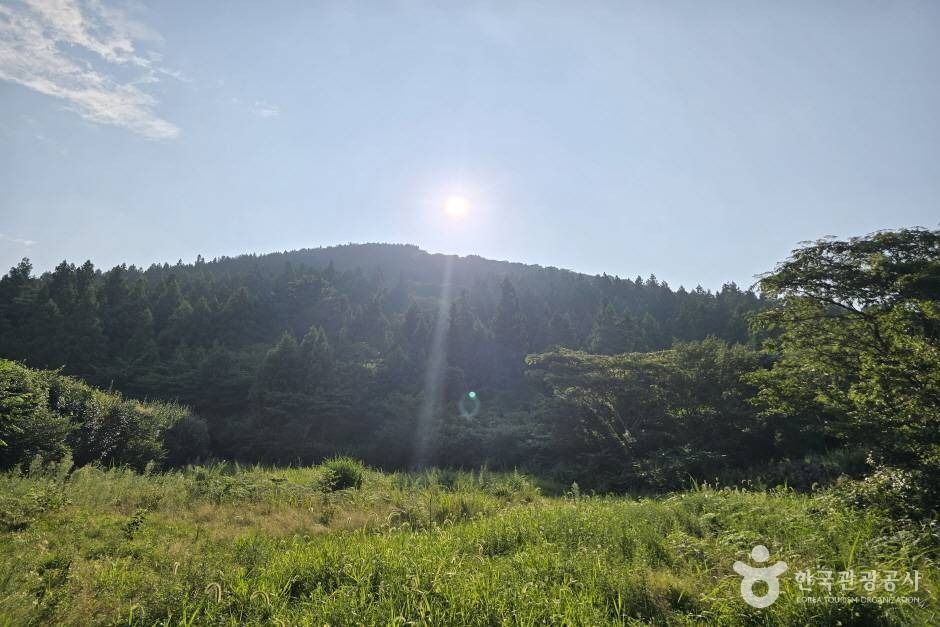
Among them, Baneul Oreum is the one you'll come across in photos fairly often, and it's also the oreum in the photo GYULI brought along today. The other six — Budae, Buso, Gatdot, Daeheul, Min, and Saewa Oreum — are said to be relatively less well-known by name. That doesn't mean they're any less special, though. To me, the fact that so many oreum sit packed closely together within one neighborhood, Jocheon-eup's mid-mountain area, is what makes it interesting in the first place. Rather than searching for each oreum one by one, many accounts suggest that once you know this neighborhood has a lot of oreum and simply follow the mid-mountain roads, you naturally come across several of them along the way.
Seven oreum clustered together in one neighborhood — GYULI thinks that alone can be reason enough to tour Jocheon-eup's mid-mountain area.
— 🍊 GYULITouring It as a Course — the Fun of Moving from Oreum to Oreum
Climbing a single oreum and coming back down feels quite different from touring several as a connected course, or so it's said. The roads through Jocheon-eup's mid-mountain area are said to run between the oreum, so as you drive, the oreum you just passed drifts away behind you while another appears ahead — a scene that's said to repeat again and again. Moving from Baneul Oreum toward Budae, then on toward Buso and Gatdot, many accounts say that even if you can't remember every single name, you're left with a clear sense that 'this is a neighborhood full of oreum.' Continue on through Daeheul, Min, and Saewa Oreum, and you'll end up spending something like half a day within the mid-mountain scenery — so it starts to feel less like heading to one destination and more like making the whole neighborhood your destination.
Besides moving between the oreum by car, there's also said to be the option of picking a few and climbing them on foot. That said, how well-maintained the trails are and what hours you can access each one may differ from oreum to oreum, so I'd rather not state anything too definitively here. There's no word of these oreum requiring advance reservation the way Geomunoreum does, but rather than heading out with no preparation at all, it's probably worth checking beforehand which oreum are easy to climb right now and whether the trails are open. Whether you climb on foot or simply take them in while driving past, you should be able to feel that same sense of slowly moving through the neighborhood either way.
Worth Knowing Before You Tour the Course
There's no rule saying you have to cover all seven oreum in a single day. If you're short on time, one option is to pick just one or two relatively well-known oreum like Baneul Oreum, and if you'd rather just enjoy the mid-mountain drive itself, slowly passing by the rest could make for a perfectly good outing on its own. The mid-mountain area is said to have weather that can behave differently from the coast — it might be clear by the sea but suddenly foggy or windy once you head into the mid-mountain area. So pack extra layers, and if you're planning to climb, don't forget comfortable walking shoes. Facilities tend to cluster more around the villages than right by the oreum, so it's worth bringing water and snacks before you set out. Above all, it's best to double-check the current trail conditions or any access restrictions right before your visit.
GYULI's Tip · These seven oreum clustered in Jocheon-eup's mid-mountain area aren't said to have a fixed course or order. If you have the time, start with Baneul Oreum and tour a few in sequence; if not, driving along the mid-mountain roads and simply taking in the oreum as you pass is also a fine option. Unlike Geomunoreum, they're not said to require advance reservation, but it's worth checking each oreum's trail condition and access before you go.