From Jeju's Old Downtown to the Jocheon Sea, Walking the Length of Olle Route 18
a coastal Olle stretching to the Jocheon sea
Following the Jeju Olle route numbers one by one, you eventually find yourself right in the middle of Jeju City's old downtown, or wondosim. The route GYULI is introducing today, Olle Route 18, is said to be the course that sets off from exactly that point. Said to continue on from Route 17, this stretch is introduced as a coastal course that starts in Jeju's old downtown and walks all the way to the shore of Jocheon-eup. I want to point out first that although it shares the number 18 with Route 18-1, which requires a boat ride out to the distant island of Chujado, this is a completely different course — a mainline route walked entirely on Jeju's main island. I've heard some people get the two mixed up because of the shared number, so it's worth remembering: Route 18 is a land route from the old downtown to Jocheon, while Route 18-1 is an entirely different journey out to Chujado by boat. Leaving the city behind and passing an oreum, a port, and a black sand beach on the way to the quiet coastal village of Jocheon — today GYULI will walk you through what this course is said to hold.
Starting in the old downtown, over Sarabong, to Hwabuk Port
Olle Route 18 is said to begin in Jeju's old downtown, around the area of the former Jejumok Government Office and Gwandeokjeong, within what used to be Jeju's old walled town. Starting right from the heart of the city is said to give this route a different feel from many other Olle courses, and before long, walkers are said to reach a low-lying oreum called Sarabong. Sarabong is known as a spot in Jeju City where you can take in both sunrise and sunset, and it's often introduced as a place for walkers on this downtown course to pause and catch their breath on the way up. Past Sarabong comes Hwabuk Port, said to be one of the old, storied ports that ships once used to travel between Jeju and the mainland. It remains a quiet fishing port today, but traces like an old lighthouse and defense-related remnants are said to still be scattered around it, letting walkers sense a bit of old Jeju along the way. This area around Hwabuk Port is also often mentioned as the point where the city's buildings start to thin out and the sea breeze begins to take over.
Past Samyang Black Sand Beach, through Sinchon, to the Jocheon sea
Continuing along the coast past Hwabuk Port, the route is said to reach Samyang Black Sand Beach, a spot GYULI has already introduced. It's a stretch that runs right alongside that dark sand said to get its color from mixed-in volcanic scoria, and in summer, walkers are said to often pass people enjoying a sand bath along the way. Past Samyang, the course is said to continue through the quiet coastal village of Sinchon toward Jocheon-eup, and from this point on, traces of the city are said to fade while quiet coastal village scenery takes over. Nearing Jocheon, the route is said to pass by Jocheon Port, and right beside that port stands Yeonbukjeong, an old pavilion GYULI has already introduced separately. It's a pavilion said to hold the story of Joseon-era officials waiting for their boats and for news — since I've already covered that story in detail, I'll just note it briefly here today. If you're curious, it's worth looking up GYULI's earlier piece on Yeonbukjeong as well. Since the route only brushes past the port, it's said to be worth pausing separately if you want a proper look at the pavilion itself.
Leave the old downtown behind, pass an oreum, a port, and a stretch of black sand, and before you know it, you're said to have reached the Jocheon sea.
— 🍊 GYULIEnding at Jocheon's Mansedongsan, and the split from Route 18-1
Olle Route 18 is said to wrap up at a place in Jocheon-eup called Mansedongsan. As the name suggests, it's said to be a historic site where residents of the Jocheon area once held a mansei independence demonstration during the Japanese colonial period, and it's often introduced as a place where walkers naturally pause at the end of the course to reflect on that era. This same Jocheon is also said to connect onward to Olle Route 18-1, the point from which boats depart for the distant island of Chujado — but I want to stress again that Routes 18 and 18-1 share little more than a similar number. Route 18 is a coastal walk along Jeju's main island from the old downtown to Jocheon, while Route 18-1 is said to require a long boat ride out to Chujado from Jocheon or Jeju Port, so anyone aiming to complete the full Olle trail should plan for the two separately rather than mixing them up. Running from downtown through an oreum, a port, a beach, and a historic site, Route 18 is often introduced as a course that lets you meet several different faces of Jeju in one walk. With more everyday village scenery than flashy tourist spots, it's also said to be a course well suited to those who prefer a quiet walk.
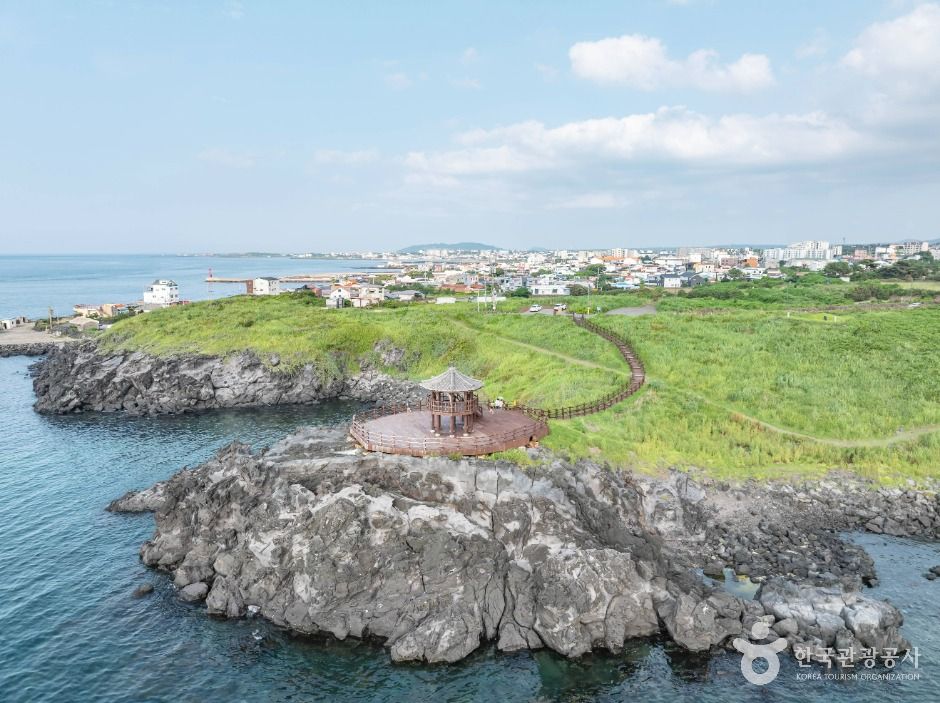
GYULI's Tip · Since Olle Route 18 runs from Jeju's old downtown to Jocheon, it's said to be a course that's easy to reach by public transit at both ends. That said, the exact distance and time it takes are said to vary depending on your pace and how many stops you make, so it's worth setting off with plenty of time to spare. Since it shares the number 18 with Route 18-1, the Chujado course, be sure to plan the two separately so you don't mix them up, and since much of the course runs along the open coast, pack a hat and plenty of water. If you'd like to stop by Yeonbukjeong near Jocheon Port, it's worth budgeting a bit of extra time to pause and look around.