Sehwa Folk Five-Day Market: Show Up on the Wrong Date and You'll Come Up Empty
is the market said to open
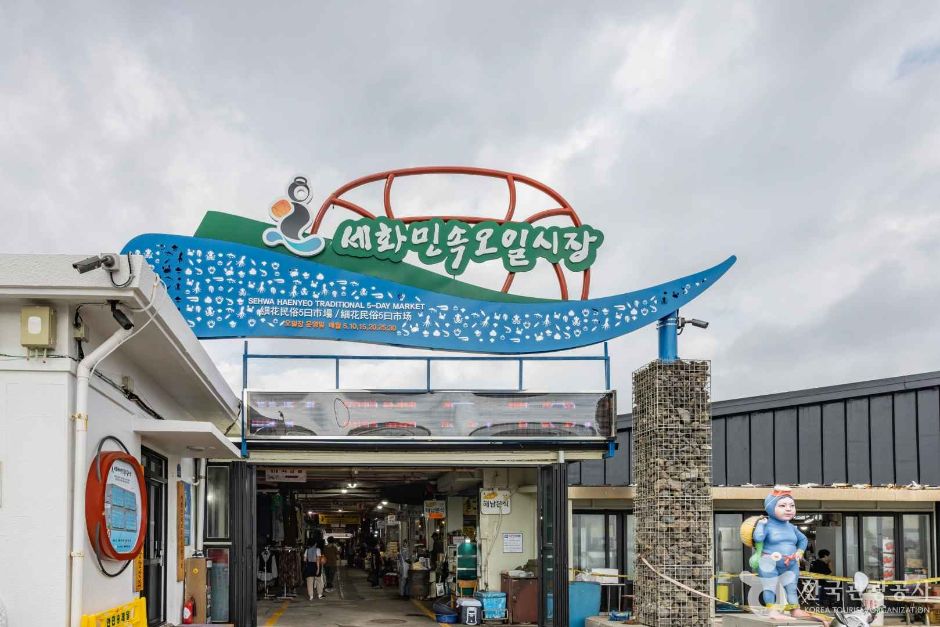
Jeju has several markets that pop open only on set dates, known as five-day markets. Among them, Sehwa Folk Market, located at 1412 Haemajihaean-ro, Gujwa-eup, Jeju City, is often mentioned as a place to find local Gujwa-area food and produce. Sitting right beside the sea, it's said to carry a mood distinct from other five-day markets. But this is not a market you can visit on just any day — it only opens on specific dates, and that's the first thing to remember. Today let's go through when Sehwa Folk Market opens, and what you can reportedly find there.
Only on Dates Ending in 5 or 0
Jeju's five-day markets are said to be scheduled differently from region to region, and Sehwa Folk Market is often mentioned as the representative market for Gujwa-eup. There's also said to be an effort to avoid overlapping with market days in neighboring townships, so if you're a traveler hoping to visit several of Jeju's five-day markets, using Sehwa Folk Market's schedule as an anchor point to plan around the others could be one way to go.
Sehwa Folk Market is said to be a five-day market, opening at five-day intervals as its name suggests. Specifically, it's said to open on dates ending in 5 or 0 — that is, the 5th, 10th, 15th, 20th, 25th, and 30th of each month. Jeju's five-day markets are generally said to rotate through dates this way, and Sehwa Folk Market is one of the markets that follows this same rhythm. Exactly how many times the market opens in a given month can vary slightly depending on how many days that month has, so if you're planning a visit, it's worth pulling up a calendar and checking the dates first.
For travelers unfamiliar with the five-day market format, it may help to think of it this way: rather than a market that's open every day, it's a space where vendors gather and set up only on specific dates. So if you want to fit Sehwa Folk Market into your itinerary, checking 'is this actually a market day' should come before any other planning. While preparing this story, I found myself double-checking the date calculation more than once — that's how important this part felt.
Local Gujwa Produce and Food
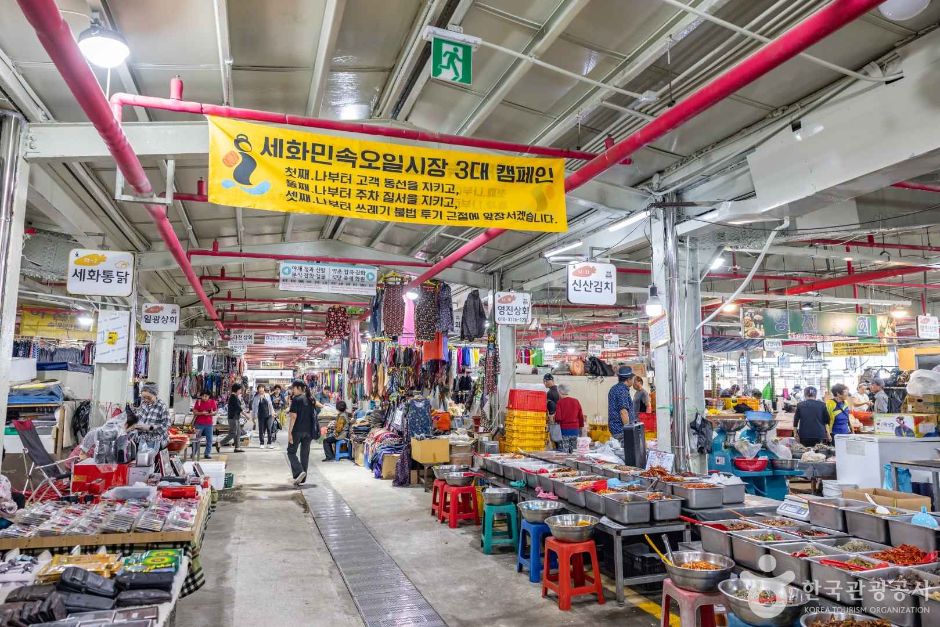
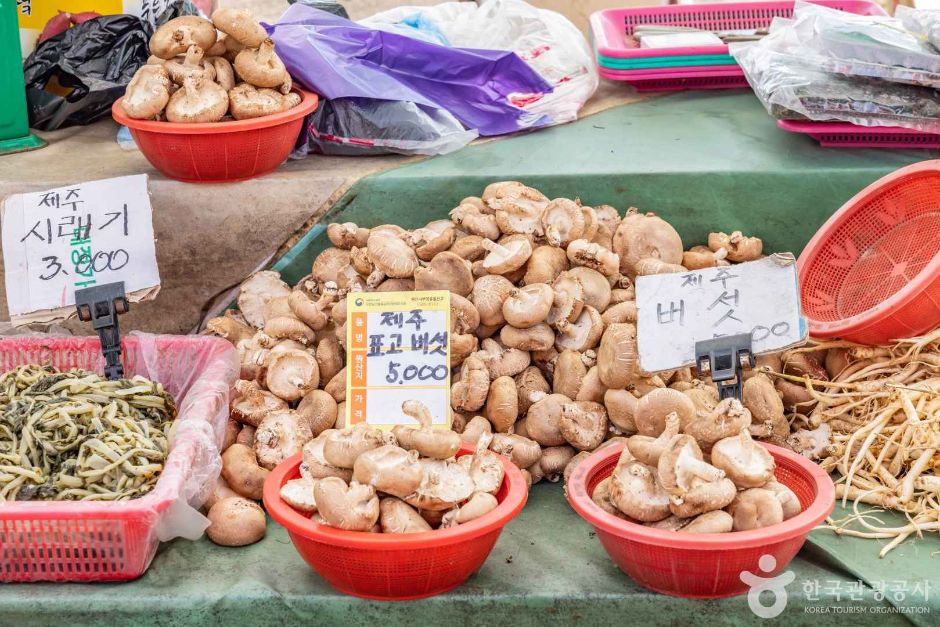
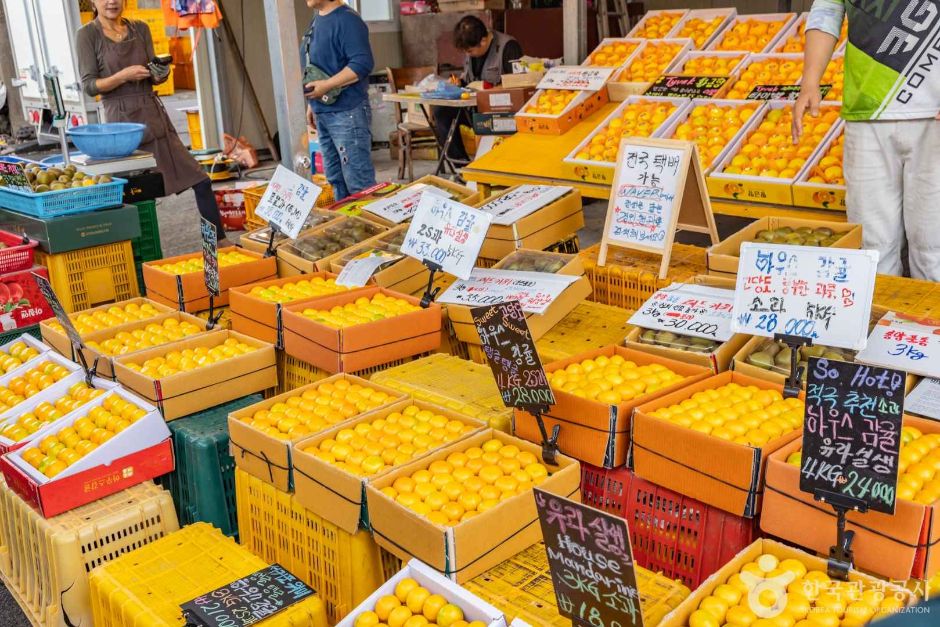
On market days, Sehwa Folk Market is said to be full of local produce from around Gujwa-eup. From seasonal vegetables that look freshly pulled from the field to seafood caught fresh, being a coastal town, each stall is said to lay out a slice of Gujwa's everyday life for that particular day. Since Gujwa-eup is also well known as a carrot-growing area, carrot-based food — like Gujwa's carrot bread — is said to show up around here from time to time as well. Exactly which stall sells what can change a bit from market day to market day, though, so I'd rather leave that part as a discovery for you to make in person.
The distinct energy of a five-day market is said to be another part of its charm. Unlike a supermarket with neatly displayed fixed prices, the back-and-forth haggling between vendor and customer, or the calls announcing what's freshly arrived that day, are said to create an atmosphere unique to this kind of market. For local residents, it's a practical place to stock up on daily goods, while for travelers, it's often introduced as a chance to get a close look at the everyday rhythm of Jeju life.
Seeing the energy of a market day in person gives you a sense of Jeju's daily rhythm that you just can't get at a supermarket.
— 🍊 GYULI
It Can Be Quiet on Days the Market Doesn't Open
This is the part to be most careful about with Sehwa Folk Market. On days that aren't market days, the stalls that are usually bustling are said to disappear entirely, and the market's distinct energy vanishes right along with them. You might end up facing nothing more than an empty, quiet lot. Because it's close to Sehwa Beach, many people are said to stop by while passing through the area — but if that day happens not to be a market day, you could end up walking away having seen only a quiet space instead of the market scene you were hoping for, which can be a real letdown.
So if you're planning to add Sehwa Folk Market to your itinerary, it's worth building a habit of double-checking the date before you set out. Once you remember the rule — the 5th, 10th, 15th, 20th, 25th, and 30th — the calculation itself isn't hard, so marking market days on your calendar ahead of time when planning your trip is one way to go. With just that small check, you can experience two completely different sides of Sehwa-ri: the bustle of a market day, and the quiet of a day without one.
If you're visiting Sehwa Folk Market on a market day, it's worth aiming for a leisurely mid-morning arrival rather than showing up too early or too late. Vendors are said to have just finished laying out their goods by then, so the selection tends to be at its widest, and the crowds haven't built up yet either, making it easier to browse at a relaxed pace. Late afternoon, on the other hand, is said to feel more like closing time, with the best items often already sold, so it's worth factoring the time of day into your plans.
Sehwa-ri is known for having spots worth visiting near the market too, like Sehwa Beach. If you're planning a trip around a market day, one option people suggest is spending the morning browsing local Gujwa food at the market, then heading over to the beach in the afternoon to enjoy the sea.

GYULI's Tip · Sehwa Folk Market is said to open only on dates ending in 5 or 0, so be sure to check the date before you visit. Go on a non-market day and you may find only a quiet, empty space. If you do visit on a market day, bring some cash, and a market bag or eco-bag will make it easier to carry everything you pick up. If you're buying fresh produce, it's worth stopping by earlier in your trip rather than near the end, so you can plan for how you'll store it.