Thought Seobinbaeksa's White Sand Was Coral? It's Actually Rhodolith
the real story behind the white sand
Any conversation about Udo Island tends to circle back to Seobinbaeksa. GYULI touched on its white sand briefly in an earlier piece covering a full loop around Udo, but today the focus narrows to just that white sand itself. Seobinbaeksa is widely known by the nickname Coral Beach, but the white grains are reportedly not coral at all — they're said to be something called rhodolith, a term that probably doesn't ring a bell for most people. Today GYULI wants to walk through what rhodolith actually is, why it was mistaken for coral for so long, and what to keep in mind when visiting this unusual beach. Plenty of people who've already been to Udo likely walked across this sand without ever learning what it really is, so hopefully today's story changes how the beach looks on your next visit.
Not Coral? Meet the Rhodolith
The white grains covering Seobinbaeksa are known as rhodolith. As the name suggests, they're said to be connected to red algae, a type of seaweed with a reddish tint. Certain species of red algae are said to accumulate calcium carbonate within themselves as they live, and over a very long stretch of time, they harden into round, firm little clumps resembling gravel or tiny twigs. These clumps, formed on the seafloor, are then broken apart and smoothed by waves and currents before washing up and piling onto the beach — that's the story behind Seobinbaeksa's white sand. Strictly speaking, then, these grains aren't sand in the usual sense so much as the remains of algae that lived and built up over a long time. Their color and surface texture happen to closely resemble crushed coral, which is reportedly why they were mistaken for coral fragments for so long. Many visitors say that scooping up a handful feels distinctly different from typical fine beach sand — slightly rough yet rounded — and that the feeling changes once you realize each grain is something red algae spent a long lifetime building.
Why the Nickname Coral Beach Stuck Around
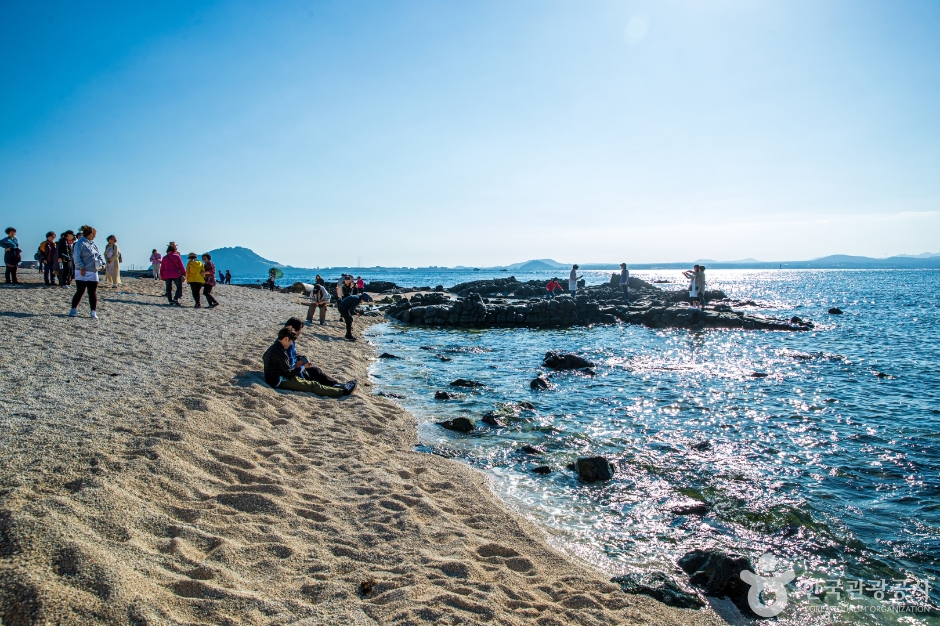
Even after it became known that the grains aren't actually coral, the nickname Coral Beach reportedly stuck to Seobinbaeksa. GYULI's guess is that the white or faintly pink color and bumpy surface simply looked so much like the coral people picture in their heads that the familiar nickname took hold before the more accurate name did. Under strong midday sun the grains are said to shine nearly white, while on overcast days or when damp, a faint pink or apricot tone is said to show through — so the color reportedly looks a little different depending on the time and weather. Many accounts also mention how striking it looks when the shallow, clear water lets the jade-toned sea show through between the grains. That said, the exact color and shimmer are said to shift with the season, weather, and the day's tides and waves, so it's worth keeping in mind that the impression can vary quite a bit depending on when you go. Compared with Udo's other natural scenery, many say Seobinbaeksa's color and texture stand apart in a category of their own.
Look closely and each grain looks like a tiny piece of coral, but it's said to actually be the trace of red algae built up over a very long time.
— 🍊 GYULIWhy It's Said to Be a Natural Monument, and What to Keep in Mind
Beaches formed from a wide accumulation of rhodolith like Seobinbaeksa are said to be a rare case even by global standards. That's reportedly reflected in how highly the beach is valued, both academically and as a natural resource, and it's said to be the reason Seobinbaeksa is designated and protected as a natural monument. That said, GYULI is cautious about stating the exact designation name, number, or year with confidence, so it's worth checking with the relevant authorities before your visit for precise details. What matters most is that these white grains take an extremely long time to form and aren't something people can easily restore once disturbed. So it's best to avoid scooping up a handful of sand or digging into the grains out of curiosity. There's said to have been a period when visitors regularly took a bit of sand home as a souvenir, and that habit is now reportedly cited as one cause of damage to the beach — so it's best to take it in with your eyes and touch it only lightly.
Plenty of people apparently give Seobinbaeksa only a quick stop on their loop around Udo, but once you know what these white grains really are, looking again tends to feel like it's worth more than a passing glance. Walking slowly while picturing each grain underfoot as something red algae spent a lifetime building can make the same beach feel like it carries a bit more weight. Rather than rushing off after a few photos, many say that sitting for a moment to watch where the water's color meets the sand's color is one of the best ways to properly take in Seobinbaeksa. Even within a full tour of Udo, Seobinbaeksa is a reminder that a different story can be hiding under every spot you step on.
GYULI's Tip · Since Seobinbaeksa is said to be a designated natural monument, please avoid collecting or taking sand or grains with you. The beach's color and mood are said to shift with the season, weather, and tides, so it's worth checking the latest information before you visit.