From Jeoji to Seogwang — Walk Olle Trail No. 14-1, Through Another Gotjawal Forest
a branch route said to run through a gotjawal primeval forest
Jeju Olle isn't just made up of the numbered main routes running from Route 1 to Route 21 — it's said to also include several branch routes that split off from the main trail along the way. A branch route can be thought of as a side path that leads to a different village or scenery than the main route, and Olle Route 14-1, which GYULI is introducing today, is said to be one of these branches. If Olle Route 14, introduced earlier, is the main route said to start in Jeoji-ri, Hangyeong-myeon and run toward Hallim, Route 14-1 is said to split off from that same Jeoji-ri and turn instead toward Seogwang-ri, Andeok-myeon. Not only is the destination different, but the scenery along the way is also said to have a different character — and the biggest feature of Route 14-1 is said to be that most of the course passes through gotjawal terrain. GYULI has introduced Hwasun Gotjawal before, located in the Hwasun-ri area of Andeok-myeon, Seogwipo, and I want to note upfront that the gotjawal on today's Route 14-1 is said to sit in a completely different area from that one. Even though they share the name gotjawal, the location and the walking experience are said to differ, so today GYULI will go through what this branch route between Jeoji and Seogwang is said to be like. That said, I'll be careful not to confidently pin down the exact total distance or how long it takes, so I'll stick to passing along what's said about it as honestly as I can.
What is Route 14-1, a branch different from Olle Route 14?
Olle courses with a number followed by '-1,' like this one, are said to be called branch routes that split off from a main route. If the main route is the trunk, a branch is the offshoot that extends from it, and it's said to often pass through different villages or take in scenery hard to find on the main route. Olle Route 14-1 is said to be one such branch — it's said to start from the same Jeoji-ri, Hangyeong-myeon as Olle Route 14, but its endpoint is said to be Seogwang-ri, Andeok-myeon, rather than Hallim. Jeoji-ri has long been known as a village with a wide stretch of gotjawal, and along the stretch from this Jeoji-ri area to Seogwang-ri, Route 14-1 is said to spend a larger share of its distance passing through gotjawal forest paths than village roads or coastal paths. Perhaps because of this, among people who've walked many Olle routes, Route 14-1 is sometimes said to be referred to as 'the branch where you can really feel gotjawal.' That said, branch routes are said to be relatively less known than main routes, so signage and guide materials may not be as dense as on the main route, so first-timers may want to bring a course map ahead of time.
From Jeoji to Seogwang, a path that leads through gotjawal
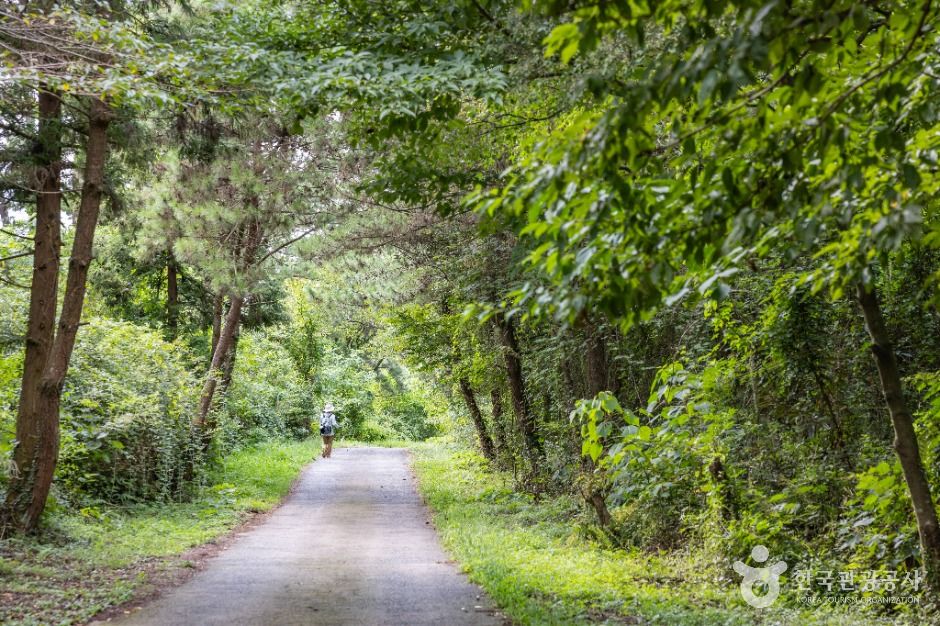
Accounts from people who've walked Olle Route 14-1 often mention that the distinctive gotjawal scenery — trees and vines tangled together — continues throughout much of the walk. The gotjawal near Jeoji-ri is said to be a forest that grew on its own, with trees and plants tangled over jagged terrain left by flowing lava, and Route 14-1 is said to pass through this gotjawal terrain for a fairly long stretch. There's word that open farm paths and village roads are mixed in here and there along the way, but many accounts say it's the dense gotjawal forest path that shapes the overall impression of the course. Closer to Seogwang-ri, the route is said to open into typical Jeju mid-mountain scenery lined with stone field walls, and some accounts describe the contrast as striking — stepping out of the gotjawal's deep forest shade into open farmland. That said, how the course splits between gotjawal forest path, village road, and farm path in each section is said to be described a bit differently depending on the source, so I'll be careful not to settle on just one version. Still, what comes up consistently is that the stretch from Jeoji to Seogwang keeps gotjawal — a forest unique to Jeju — close by for a long stretch of the walk.
From Jeoji to Seogwang, it's said to be a path that keeps a gotjawal forest close by — one with a different face from Hwasun Gotjawal.
— 🍊 GYULIA different gotjawal from Hwasun — what to know before you walk
Hwasun Gotjawal, which GYULI introduced before, is an ecological trail located in the Hwasun-ri area of Andeok-myeon, Seogwipo, while the gotjawal on today's Olle Route 14-1 is said to be a completely different stretch of gotjawal, running from Jeoji-ri, Hangyeong-myeon to Seogwang-ri, Andeok-myeon. Jeju is said to have several gotjawal forests scattered across this kind of lava terrain, and the gotjawal near Jeoji is also said to look close to a primeval forest, with trees, vines, and ferns tangled together much like Hwasun Gotjawal. That said, unlike Hwasun Gotjawal's short loop trail, Olle Route 14-1 is said to be a one-directional walking course running straight from Jeoji to Seogwang, which is said to make the walking experience feel different. Because of the gotjawal terrain, many accounts mention sections where bare rock is exposed, so comfortable walking shoes are worth bringing, and while long shaded stretches are said to keep the walk relatively cool even in summer, the ground is also said to get slippery after rain. Many accounts say you can just follow the Olle Trail's usual ribbon and arrow markers, but since this is a branch route, some reviews mention the markers may appear less often than on the main route, so bringing a course map ahead of time is worth doing. The exact total distance, time, and difficulty are said to vary depending on the section and your condition that day, so it's hard to pin down in advance — checking the latest information before you go is recommended.
GYULI's Tip · Olle Route 14-1 is said to be a Jeoji–Seogwang branch route that passes through a different area of gotjawal from Hwasun Gotjawal, so bring a course map ahead of time to avoid mixing it up with Olle Route 14 (Jeoji–Hallim), and pack comfortable walking shoes since sections of bare rock may appear along the way.