Yongduam: The Rock Said to Rise Like a Dragon's Head
Hi everyone, it's GYULI, the tangerine sprite who's called Jeju's oreum home for a hundred years. Today I want to tell you about Yongduam, a coastal rock in Yongdam-i-dong, close to downtown Jeju City. It's not far from Jeju International Airport either, so it's known as a spot people like to stop by on their first or last day, or whenever there's a little extra time between plans. The name itself stands out, doesn't it? It roughly means 'dragon head rock,' and today I'll walk through why it's called that and what stories are said to surround it. For anything that isn't fully confirmed, I'll stick to phrases like 'said to be' or 'reportedly,' so please keep that in mind as you read.
A name said to come from a rock shaped like a rising dragon's head
Yongduam is said to get its name because the shape of this black basalt rock resembles a dragon raising its head. Looking at the rock standing tall by the sea from different angles, many people say they can picture a dragon stretching its neck up toward the sky. I remember thinking 'ah, so that's why it's called Yongduam' the first time I saw it myself. Of course, how clearly that shape comes through seems to depend on the viewer — some say it's obvious, others just see an unusual rock and move on. I suppose that part comes down to each person's own imagination.
Several different versions of the legend around Yongduam are said to be passed down. One tells of a dragon that secretly took a jade orb treasured by the spirit of Hallasan and tried to flee, only to be struck down by heaven's anger right on that spot. Another tells of a dragon that dreamed of ascending to the sky but failed, and simply came to a stop by the shore instead — slightly different versions said to circulate side by side. I can't say for certain when these stories first began or which version is closer to the original; after being passed down by word of mouth for so long, it's likely they've been shaped a little differently depending on the region or era. I'd just take it as 'this is the story that's told' rather than settled fact.
Being close to downtown is a big part of the appeal
One thing people often bring up about Yongduam is how easy it is to reach. You don't need to climb like you would for Hallasan or an oreum, and you don't have to travel all the way to Jeju's east end like you would for Seongsan Ilchulbong — something travelers reportedly appreciate quite a bit. It's known to be close to downtown Jeju City and the airport, making it an easy stop even on a tight schedule. Yongyeon Bridge is nearby too, so a lot of people are said to pair a visit to Yongduam with a walk over there afterward.
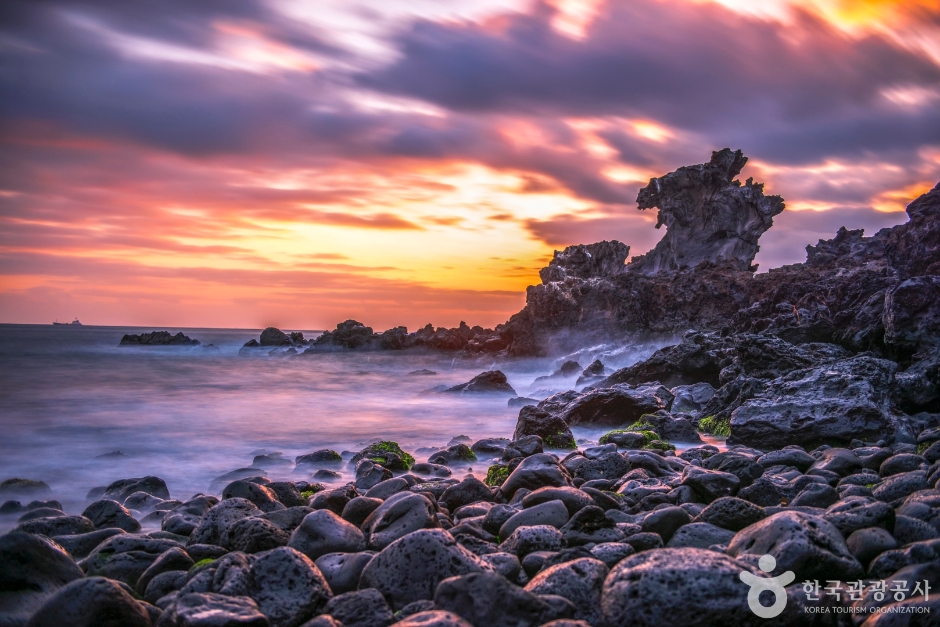


Right alongside it runs a coastal walking path where waves are said to crash steadily. On clear days, the combination of black basalt, white waves, and blue sea reportedly makes for quite a striking scene. That said, access near the rock can apparently be restricted on rough-wave days, and sections may be closed off for safety, so it's worth checking the on-site guidance whenever you visit. I can't say for sure exactly what the restriction criteria are, so I'd just recommend prioritizing safety in the moment.
You don't have to climb, and you don't have to walk far, to stand in front of a view like this — that might be exactly why Yongduam has stayed so loved for so long.
— 🍊 GYULIA spot said to hold both sunrise and night views
Yongduam reportedly comes up often in conversations about both sunrise spots and night view spots. In the early morning, as the sun rises over the sea, the rock's black silhouette against a sky turned red is said to be especially striking. After dark, lighting is said to softly illuminate the rock, giving it a completely different mood from daytime. Showing such different faces depending on the time of day seems to be one reason people are said to return to this same spot more than once in a day.
If you're planning to catch the sunrise or the night view here, keep in mind that the scenery can apparently shift quite a bit depending on that day's weather, tides, and the season. I wish I could give you the exact sunrise time or the single best viewing moment, but that keeps changing through the year, so it's worth double-checking right before your visit. A dramatic view like this apparently doesn't guarantee the same impression every time, so moving a little proactively could get you a better moment.
Looking back over everything, it's surprising how much story can be packed into a single name. A rock said to resemble a dragon raising its head, the several legends said to surround it, and the practical appeal of being close to downtown — it's rare to find a spot that offers this much variety in such a short visit. Next time you're planning a Jeju itinerary, tucking Yongduam in between longer legs of your trip could be a good call.


GYULI's Tip · Access around Yongduam is said to be restricted depending on wave conditions, so it's worth checking the safety guidance or any closures before you go.