What's an oreum? Look at Yongnuni Oreum's ridge and you'll know
Talk about traveling in Jeju long enough and the word 'oreum' comes up constantly. Seongsan Ilchulbong is an oreum, there's one near Sanbangsan, and pretty much every travel guide has an oreum name attached somewhere. But ask someone 'what exactly is an oreum?' and a lot of people go quiet. Is it a hill, a mountain, or something else entirely? Today I want to slowly unpack this word that's both unfamiliar and oddly familiar, and talk about Yongnuni Oreum, the one people mention most often as a kind of representative example. This isn't a hiking-course guide — I just wanted to have an easy conversation about what an oreum actually is as a landform, and why Jeju is said to have so many of them.
An oreum is said to be a trace left behind by a volcano
'Oreum' is a Jeju dialect word said to refer to a small volcanic landform. It's said to trace back to the verb meaning 'to rise,' which makes sense for a name describing land that swells gently up out of flat ground. Academically, these are often called parasitic or flank volcanoes, according to what's commonly said — as the larger volcanic island of Jeju was forming, countless small craters are said to have opened up separately across it, and what's left of them today are the low hills we now call oreum. In that sense, each oreum is said to be a living trace of the fact that Jeju itself was born from volcanic activity.
What's interesting is that a great many of these oreum are said to be scattered across Jeju. Exactly how many is something that seems to be told a little differently depending on the survey or the period, so I'll be careful not to pin down one specific number here — but what does seem to come up consistently across sources is that hundreds of oreum, roughly speaking, are said to be scattered across the island. That alone suggests oreum are a truly fundamental building block of Jeju's landscape, which is probably why you often see Jeju described as 'the island of oreum.'
Why Yongnuni Oreum, of all of them, is said to be so beloved
Among all those oreum, Yongnuni Oreum is said to be one of the names that comes up especially often. Located, it's said, around Jongdal-ri in Gujwa-eup, Jeju City, this oreum's biggest distinguishing feature, compared to others, is said to be its unusually soft, gently curving ridgeline. Instead of a sharp peak, the shape is said to roll on like a wave rolling in slow motion. That's probably part of why it's said to be especially beloved among photographers. In the early morning when the sun sits low, or around sunset, long shadows are said to fall along the ridge and make the curves stand out even more — and quite a few people are said to time their visits around exactly those hours just to capture that scene.
Not a peak jutting sharply upward, but a ridge that rolls on softly like a wave — that's said to be why Yongnuni Oreum stays with people.
— 🍊 GYULIHearing all this, it struck me that an oreum probably isn't just scenery to be consumed. In Jeju, oreum slopes are said to have long sat close to the villages, sometimes used as pastureland for cattle and horses, and sometimes holding villagers' family graves. So an oreum was never just a 'nice-looking hill' — it's said to have long been intertwined with the daily lives of the people living nearby. These days it's a place travelers visit for photos, but before that it's said to have been someone's workplace, the resting place of someone's family, a back hill where village children used to run around — and knowing that makes it feel like there's a little more depth to look at when you see one.
One oreum seems to say a lot about the island of Jeju itself
Where Yongnuni Oreum is said to have a soft ridge, other oreum are said to still carry a clearly visible crater, making their peaks look almost split into several separate points. It's fascinating that landforms born from the same kind of volcanic activity are said to have ended up looking so different from one another. It's a bit like how no two faces look exactly alike — each oreum, it seems, ended up with its own distinct expression. People who know Jeju well are said to be able to picture roughly what an oreum looks like just from hearing its name. I'm not quite there yet, but every time I learn a little more about oreum like this, Jeju itself starts to feel like it has more dimension to it, and I like that.
Getting to know an oreum, in the end, seems to mean getting to know how this island was born and how people have lived on top of it ever since. Next time you find yourself in front of a ridgeline — Yongnuni Oreum's or any other — try not to stop at 'nice view.' Give a thought to how this hill is said to be a trace of ancient volcanic activity, and how it's said to have long been tied to the lives of the people living around it. The same scenery really does look different once you know the story behind it.
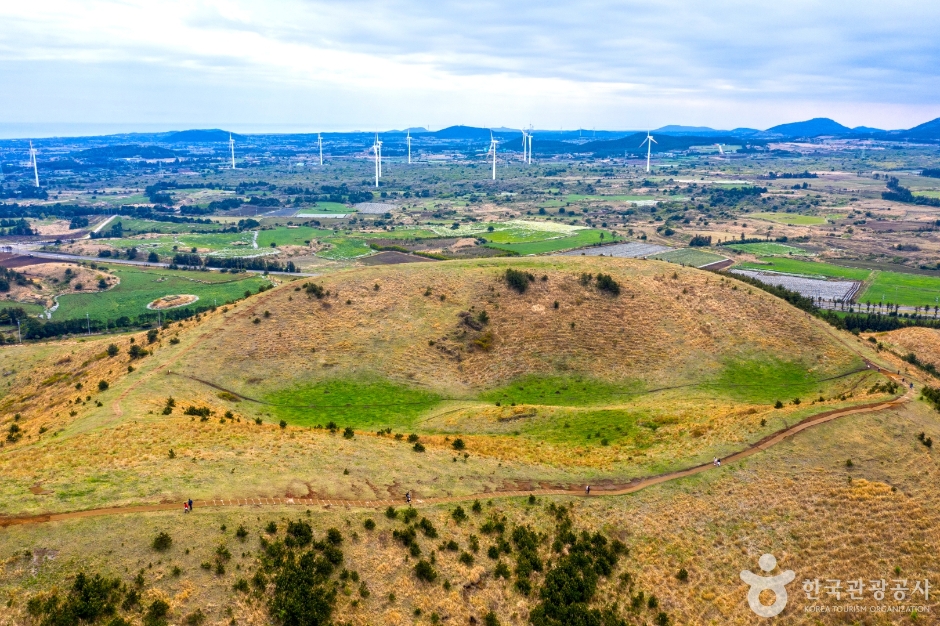
GYULI's Tip · An oreum's ridgeline is said to look far more distinct in early morning or around sunset, when the low sun casts long shadows along the curve. If you're hoping to capture it in a photo, that's the time to aim for.