Never Heard of Jeobjjakppyeo-guk? GYULI Always Reached for This First on Feast Days
with buckwheat flour
Mention Jeju feast food and momguk is often the first dish that comes to mind, but there's another soup said to have stood right alongside it: jeobjjakppyeo-guk. It's made by boiling pork down into a rich broth, then stirring in buckwheat flour to thicken it. The unfamiliar name alone leaves many people unsure what kind of dish it actually is. It's said to have appeared on Jeju feast tables together with momguk, but the two soups are said to differ both in ingredients and in how their thickness is achieved. Today, let's set momguk aside for a moment and take a slow look at jeobjjakppyeo-guk on its own terms.
So What Exactly Is This Unfamiliar-Sounding Soup?
The name jeobjjakppyeo-guk can sound unfamiliar even to some on Jeju hearing it for the first time. 'Jeobjjakppyeo' is said to be a Jeju term referring to a specific cut taken when preparing pork — an expression said to cover not just the meat, but the bone, cartilage, and the flesh clinging around it. Exactly which cut it refers to in standard terms is said to vary slightly depending on the source, which is part of why people still ask which part of the pig the soup is actually made from. What's consistently said, though, is that the pork is simmered bone-in for a long time to draw out a rich broth. Over the long simmer, the essence released from the bone and cartilage is said to dissolve fully into the broth.
The biggest difference between jeobjjakppyeo-guk and momguk is said to lie in what thickens the broth. While momguk gets its thickness and aroma from mozaban seaweed, jeobjjakppyeo-guk is said to be thickened by stirring in buckwheat flour. The flour is added little by little into the broth while stirring continuously, gradually thickening the soup — added too quickly it clumps, and mixed too thin it never reaches the dish's signature heartiness, according to tradition. So how much buckwheat flour goes in, and at what pace, is considered a key mark of skill that shapes the final taste. The finished broth is said to take on a pale, thick appearance as a result.
Jeobjjakppyeo-guk is said to be a soup whose flavor can change with nothing more than the pace at which the buckwheat flour is stirred in.
— 🍊 GYULIWhy It's Said to Have Stood Alongside Momguk on the Feast Table
On Jeju, it's said that whenever a major life event like a wedding or a funeral called for a feast, villagers would gather to butcher a pig and prepare food together. The broth drawn from boiling the pork was then divided to make different soups, according to tradition — add mozaban and it became momguk, stir in buckwheat flour and it became jeobjjakppyeo-guk. Starting from the same pork broth but finishing as entirely different soups depending on what was added is something many find notable. Both soups are said to have been ladled generously from a big cauldron and served widely to guests, with jeobjjakppyeo-guk regarded as the heartier, richer of the two.
One story behind why jeobjjakppyeo-guk mattered on the feast table has to do with the care packed into a single bowl. Simmering the bone for hours and getting the buckwheat thickness just right is said to have been labor-intensive work, and that effort is said to have been seen as a way of honoring guests. Leftover soup is also said to have been shared with neighbors once a feast wound down, a custom said to resemble momguk's own tradition closely. That said, exactly when jeobjjakppyeo-guk came to be prepared this way isn't documented with certainty; it's said to have been passed down only through oral tradition across villages and generations.
Buckwheat Flour and Its Thick, Hearty Broth
Buckwheat is said to have long been widely grown on Jeju. Known for growing relatively well even in the island's poor volcanic soil, buckwheat is said to have found its way into many dishes in a place where rice farming was difficult. The buckwheat flour used in jeobjjakppyeo-guk is thought to have taken root in the dish for this same reason, adding a distinct nutty aroma and a faintly grayish tint to the broth unlike what flour or starch would give. Broth thickened with buckwheat flour is said to hold its thickness well over time without thinning out much, a quality said to have suited it especially well to feasts where guests had to be served for hours on end.
These days, a growing number of travelers are said to be seeking out jeobjjakppyeo-guk. Still, like momguk, it isn't the secret specialty of any one particular place — it's better understood as a dish carried on in its own way by local eateries and households across Jeju. How much buckwheat flour goes in, how long the broth is simmered, and the side dishes served alongside are all said to vary slightly from kitchen to kitchen, so no single bowl can really claim to capture all of it. If you come across a local Jeju restaurant serving jeobjjakppyeo-guk while traveling, it's worth enjoying its own particular thickness and nutty aroma, distinct from momguk, just as it is.

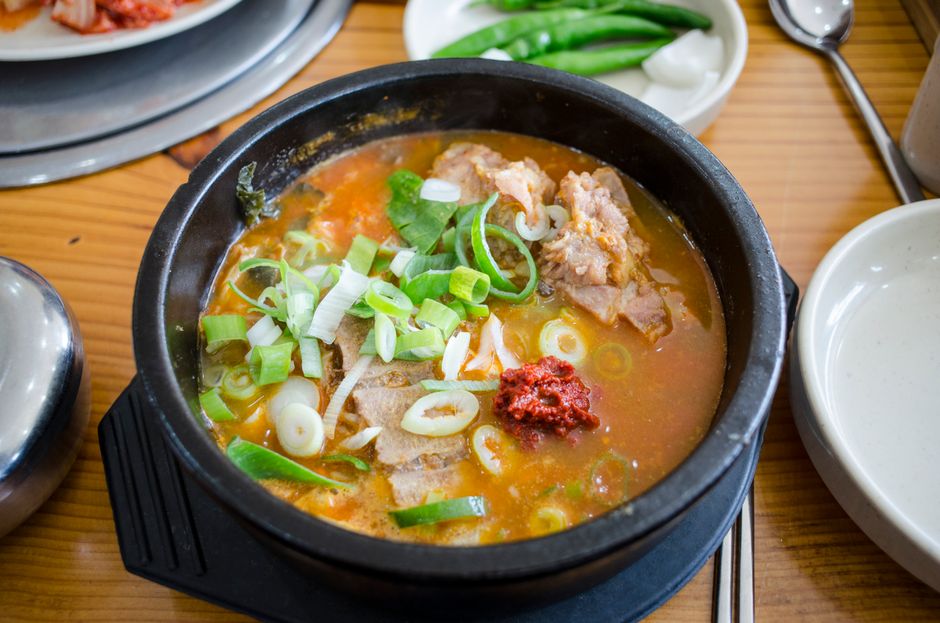
GYULI's Tip · Jeobjjakppyeo-guk, like momguk, is said to taste best served piping hot, when the buckwheat thickness and rich broth come through most clearly. Since the broth is known to firm up quickly as it cools, it's best enjoyed hot, right when it's served.